
The Danger of Catching Falling Knives
Plus: Brent crude breaches $115 amid Middle East escalation. Traders hoping for a dovish lifeline from the Federal Reserve on Wednesday were left completely empty-handed. While central bankers possess the power to print currency, they cannot magically manufacture petroleum. Brent crude blasted past the $115 threshold this morning, accompanied by a massive spike in European natural gas prices after an Iranian attack severely damaged Qatar's massive natural gas infrastructure. Consequently, pre-market indicators suggest a red open for Wall Street, while traditionally safe Treasury bonds are selling off as inflation panic intensifies.
3/19/20263 min read
Why Buying the Dip Can Destroy Your Portfolio
Even before the geopolitical chaos in the Middle East triggered this month's extreme volatility, underlying market currents were deeply unsettled. The rapid, disruptive evolution of artificial intelligence has repeatedly sent various blue-chip equities into sudden tailspins.
Whenever a major ticker nosedives, financial headlines typically scream about "massive selloffs." Yet, for every unloaded share, a willing buyer stepped up, betting the newly slashed price represented a brilliant bargain. Were these bargain-hunters making a fatal error?
According to one of Wall Street's most time-honored maxims—"never try to catch a falling knife"—they absolutely were. Furthermore, a massive pile of academic research backs up this old adage.
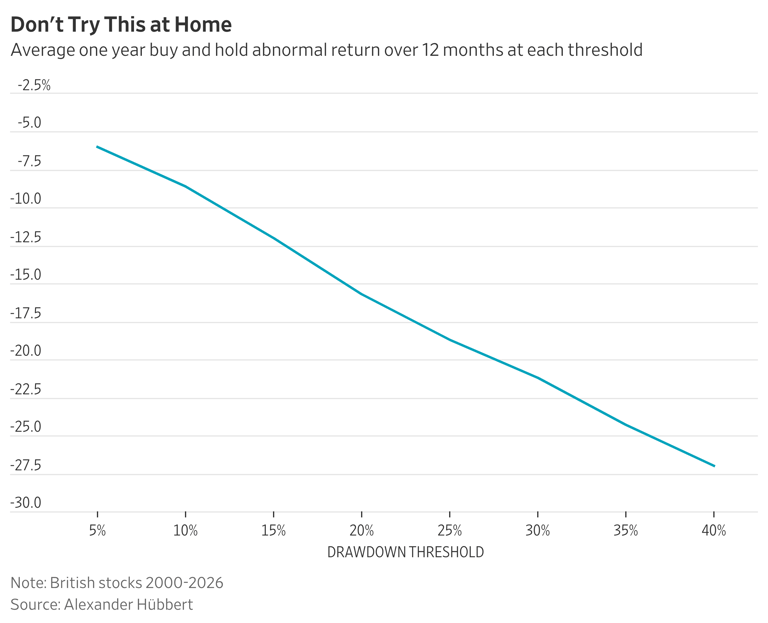
Alexander Hübbert, a quantitative researcher pursuing his Ph.D. at Stockholm University, recently crunched the numbers, and the results are undeniable. His study examined 4,174 British equities between the years 2000 and 2026. He isolated stocks that had retreated from their all-time highs by specific increments (5, 10, 15, and 20 percent) by month's end, and then tracked their performance against the broader market over the subsequent 12-month period.
The data is brutal. Equities that suffered a 5% drawdown went on to underperform the broader market by an average of 6 percentage points. A 10% pullback led to an 8.6 percentage point lag, and a 15% plunge resulted in a massive 12 percentage point underperformance. Simply put: the faster the knives fell, the deeper the financial wounds.
Momentum remains one of the most reliable forces in finance, operating just as powerfully on the downside as it does on the upside. Other quantitative strategies that attempt to buy equities near their 52-week lows yield similarly depressing outcomes to Hübbert's findings.
Naturally, market rules have exceptions. Legendary investor Howard Marks, co-founder of Oaktree Capital Management, actually advocates for buying during a crash in his book Mastering the Market Cycle. He notes that most portfolio managers are paralyzed by fear while an asset is plummeting. The catch? "When the dust has settled and investors’ nerves have steadied, the bargains will be gone."
Marks boasts an elite track record in distressed-credit investing; in fact, Warren Buffett publicly admits to reading his memos. However, this perfectly illustrates the trap: blindly grabbing a recognizable stock just because it tumbled is vastly different from possessing a highly sophisticated valuation model amidst a panic. Simply put: you are not Warren Buffett.
As the old saying goes: "The young man knows the rules, but the old man knows the exceptions."
Key Equities in Focus
Micron Technology: Despite reporting that quarterly sales nearly tripled due to insatiable demand, the memory-chip giant saw its stock drop over 4% in premarket trading. This pullback follows the stock closing at an all-time high on Wednesday.
Five Below: The discount retailer posted impressive quarterly profit and sales growth, driven by inflation-weary shoppers flocking to its low-priced holiday inventory. Shares leaped 8% ahead of the bell.
FedEx: The global logistics firm is scheduled to release its corporate earnings report immediately after the market closes today.
HSBC: U.K.-listed shares of the banking behemoth slipped following a Bloomberg exclusive revealing the institution is considering massive staff reductions as part of an aggressive AI restructuring.
Newmont & SSR Mining: Mining equities took a premarket beating as global futures for copper, silver, and gold experienced a sharp selloff.
Market Radar: Essential Reading
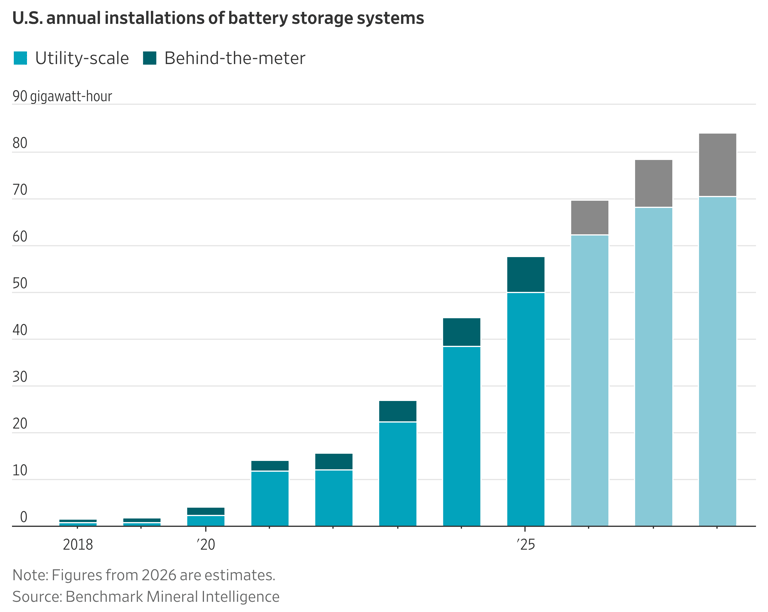
Battery Pivot: The EV revolution hasn’t lived up to its lofty expectations, leaving automakers with massive battery overcapacity. To compensate, companies like Ford are actively converting battery plants to produce utility-scale energy storage solutions.
The Value Trap: Being branded "the next Warren Buffett" sounds like the ultimate compliment, but in the finance world, it often operates more like a devastating curse.
No Rescue: Investors praying for soothing rhetoric from Fed Chair Jerome Powell during Wednesday's address were bitterly disappointed.
Credit Cracks: There is rarely just one cockroach in the kitchen. A private-credit fund loaded with consumer and small-business loans originated by fintechs like Block and Affirm is the latest segment showing severe structural stress.
Apple's AI Advantage: Despite trailing in AI development, Apple continues to print cash. Regardless of how advanced chatbots from OpenAI, Anthropic, or Google become, the iPhone remains the indispensable delivery mechanism.
Digital Grifters: Scammers are leveraging next-gen digital tools to execute crimes with ruthless efficiency. The latest Freakonomics podcast dives into their tactics and the countermeasures being deployed.
Today in Financial History
On this exact date in 1792, Wall Street experienced its first true financial crash. Dubbed the original "Black Monday," 6% Treasury bonds shed 10% of their value, and shares in the Bank of the United States plummeted 12%. The panic was triggered by William Duer, a prominent speculator and close friend of Alexander Hamilton, who had massively over-leveraged himself and was facing debtors' prison.
Lenexecute
I’m James Wilson. I spent over a decade as a senior analyst at a Greenwich-based hedge fund, managing the noise of the mid-cap and tech sectors. I’ve seen how the "big money" moves, and frankly, most retail news is 24 hours too late.
Every workday morning, I send out my Stock Market AM notes
Contact
James Wilson
Chief Market Strategist | Lenexecute
2 Greenwich Plaza, Suite 200
Greenwich, CT 06830
Direct: (203) 622-0195
lenexecute.com
© 2026. All rights reserved.